
The Science of Sound: Beyond the Hype of “Brainwave Hacking” to Real Business Productivity
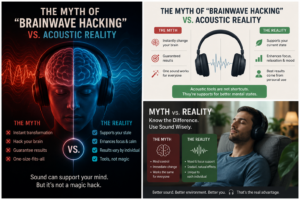
In the modern corporate world, the quest for the ultimate productivity hack is relentless. From continuous glucose monitors to intricate pomodoro variations, professionals are desperate to find an edge that keeps them locked into deep work. Unsurprisingly, a massive industry has sprung up around auditory productivity—specifically, promises of “brainwave entrainment,” “binaural beats,” and “neuro-hacking audio” that claim to mechanically alter your gray matter for instant focus.
But if you strip away the high-octane marketing and pseudo-scientific jargon, the reality of auditory productivity is far more grounded, elegant, and scientifically backed.
For sustainable business productivity, the most credible “healthy sounds” are not complex, synthetic audio tracks designed to simulate altered states of consciousness. Instead, they are the sounds humans have evolved with or adapted to over millennia: nature sounds, soft instrumental music, and simple noise masks.
An Old Egyptian Secret sound that will change you for the good check this out
Part 1: The Myth of “Brainwave Hacking” vs. Acoustic Reality
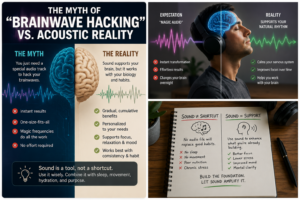
Many commercial apps promise that listening to specific frequencies will “force” your brain into an alpha or theta state, instantly granting you the focus of a Buddhist monk. While binaural beats (playing two slightly different frequencies in each ear) do have some niche support in minor clinical studies for anxiety reduction, the claims regarding drastic shifts in high-level business productivity are largely overstated.
The brain is an incredibly complex, adaptive organ; it cannot be simply “reprogrammed” by a 40Hz tone while you are trying to parse a massive financial spreadsheet.
When audio does improve focus, it usually happens through two much simpler mechanisms:
- Acoustic Masking: Drowning out disruptive, erratic background noises (like a coworker’s phone call or a clanging coffee machine) that trigger your brain’s involuntary attention switch.
- Cognitive Pacing & Mood Regulation:
Providing a predictable, non-distracting auditory backdrop that lowers cortisol (stress) and keeps your heart rate stable, allowing the prefrontal cortex to do its job.
Part 2: The Core Elements of Healthy Auditory Focus
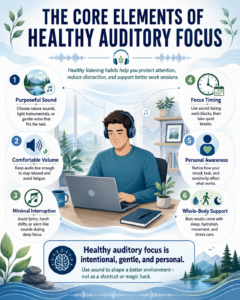
Instead of chasing hype, high-performers should focus on the three pillars of credible, evidence-based soundscapes:
1. Nature Sounds (Biophilic Design)
Humans possess an innate affinity for the natural world, a concept known as biophilia. Research from the Acoustical Society of America found that incorporating natural sounds—like flowing water, rainfall, or rustling leaves—into an office environment can mask disruptive speech while simultaneously improving cognitive functioning and optimizing worker satisfaction.
Unlike synthetic static, nature sounds have random but non-threatening variations that keep the subconscious mind calm and secure.
2. Simple Noise Masks (Color Noises)
When your environment is chaotic, you need a blanket of sound to protect your focus. This is where “color noises” come into play. While many people lump them all under the umbrella of “white noise,” they serve very different purposes for concentration:
| Noise Type | Sound Profile | Best Used For |
| White Noise | Equal energy across all frequencies (sounds like harsh static or a television tuned to a dead channel). | Masking sharp, sudden, unpredictable spikes in background noise (e.g., doors slamming, construction). |
| Brown Noise | Deeper, heavier bass frequencies with muted high notes (sounds like a distant waterfall or a low roar). | Deep, sustained concentration, calming racing thoughts, and mitigating symptoms of ADHD or high stress. |
3. Soft Instrumental Music & The Atlassian Standard
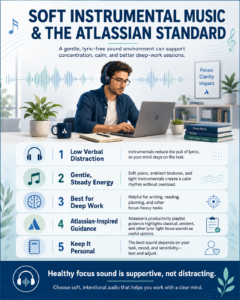
If words are involved in the music, your brain will automatically try to process them, fracturing your linguistic focus. Therefore, instrumental music is king.
But tempo matters immensely. According to workplace productivity studies highlighted by tech giant Atlassian, the sweet spot for deep work music lies between 60 and 80 beats per minute (BPM). This tempo mimics the resting human heart rate. When you listen to music in this range, your body physically relaxes, which lowers stress and induces a state of calm alertness perfectly suited for complex problem-solving.
Part 3: The 1-Week Scientific Focus Test
Because every brain is wired differently, you shouldn’t blindly trust an app’s prescription. The most effective way to optimize your acoustic environment is to run a simple, empirical self-test.
For the next three weeks, isolate one sound type per week to use exclusively during your designated deep work blocks (minimum 60–90 minutes per session).
How to Measure Your Output
At the end of each workday, rate the following three metrics on a scale of 1 to 10:
- Output (Quantity/Quality): Did you actually cross off your high-priority tasks?
- Stress Levels: Did you feel frazzled, or calm and collected?
- Focus Duration: How many times did your mind wander or get pulled away by external distractions?
The Protocol
- Week 1: Nature Sounds only (e.g., steady rainfall or a babbling brook).
- Week 2: Low-frequency Noise Masks (e.g., Brown Noise).
- Week 3: 60–80 BPM Instrumental Music (e.g., ambient electronic or classical lo-fi).
By the end of the 21 days, the data will clearly show which auditory backdrop unlocks your specific cognitive flow state.
To truly leverage the power of audio in a business environment, it helps to look at how major technology and collaboration companies approach focus. Atlassian’s internal research and workplace guidelines emphasize a concept known as Cognitive Pacing.
When we are struggling to focus, our natural instinct is often to blast high-energy, fast-paced music to “force” ourselves into action. However, neuro-ergonomic research suggests this has the opposite effect, artificially triggering a mild fight-or-flight response that increases errors and mental fatigue.
The 60–80 BPM Sweet Spot
As noted earlier, the Atlassian standard zeroes in on the 60–80 BPM range for a very specific reason: it directly influences your nervous system via auditory-motor entrainment.
[60 – 80 BPM Audio Track] —> Synchronizes with —> [Resting Heart Rate] —> Lowers Cortisol —> Triggers Alpha Brainwaves (Calm Focus)
When your auditory cortex processes a steady, repetitive rhythm within this range, it sends signals to the autonomic nervous system to stabilize. This steady pacing acts as a psychological metronome. It provides just enough sensory stimulation to keep the creative, easily distracted side of your brain occupied, while leaving the analytical prefrontal cortex entirely free to handle deep, complex tasks.
Part 8: Troubleshooting Your Auditory Environment
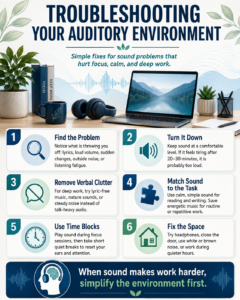
Even with the best tools, you may encounter roadblocks when setting up your new productive soundscape. Here is how to troubleshoot the most common acoustic pitfalls:
1. “The sound is giving me a headache.”
- The Cause: You are likely using white noise at a volume that is too high, or your headphones have an aggressive treble spike. White noise contains a lot of high-frequency energy which can cause ear fatigue over long periods.
- The Fix: Switch immediately to brown or pink noise, which filters out those harsh highs and emphasizes lower, softer frequencies. Additionally, lower the volume; focus audio should sit gently in the background, not dominate your attention.
2. “I’m still getting distracted by people talking near me.”
- The Cause: Your soundscape lacks sufficient “masking power,” or you are using music with occasional vocal snippets.
- The Fix: Increase the volume of your Base Masker (the brown noise layer) until the specific words of the people around you become unintelligible. Remember, the goal isn’t to block out all sound completely, but to blur the words so your brain stops trying to read or listen to them.
3. “I keep falling asleep during my deep work blocks.”
- The Cause: Your environment is too relaxing. Pure nature sounds like gentle rain or slow classical music can sometimes mimic sleep aids if you are already sleep-deprived.
- The Fix: Introduce a structural rhythm. Switch from pure nature sounds to a structured ambient electronic track at exactly 80 BPM, or choose a nature sound with more acoustic movement, like a rushing river or wind moving through a canyon.
Conclusion: Your Action Plan for Auditory Mastery
Optimizing your workspace isn’t just about ergonomics, standing desks, or dual monitors—it is about managing your sensory intake. In an era dominated by hyper-stimulating notification pings and open-office distractions, your hearing is your most vulnerable entry point for cognitive disruption.
By abandoning the hype of expensive “brainwave-hacking” applications and leaning into the empirical science of nature sounds, color noises, and carefully paced instrumental tracks, you give your brain the exact acoustic shield it needs.
Next Steps to Implement Today:
- Ditch the Hype: Cancel subscriptions to unproven “neuro-tuning” audio apps that make grand scientific claims without peer-reviewed data.
- Set Up Your Mix: Open your browser and mix a custom track using the Three-Layer Formula (50% Brown Noise, 30% Rain, 20% 60–80 BPM Instrumental).
- Commit to the 1-Week Test: Isolate your sounds, track your output, monitor your stress, and let the data dictate your ultimate focus environment.
With a intentional, scientifically backed acoustic strategy, you will find that deep focus isn’t something you have to force—it is something your environment naturally invites.