Healthy sounds for business productivity, nature music and noise the actually help you focus
Introduction: Your Work Sound Environment Matters 🔊
Business productivity is not only about having a better laptop, a bigger planner, or a longer to-do list. Your environment also matters. One of the most overlooked parts of your work environment is sound. The sounds around you can either help you stay calm and focused or pull your attention away every few seconds.
For business owners, remote workers, students, marketers, freelancers, and people trying to build a side hustle, focus is money. When you are writing content, creating ads, answering customers, building a website, studying a new skill, or planning a business, your brain needs a steady background. Random noise, loud conversations, phone alerts, traffic, and music with too many lyrics can break your concentration fast.
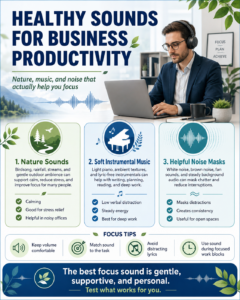
The most credible “healthy sounds” for business productivity are usually nature sounds, soft instrumental music, and simple noise masks like white noise, pink noise, or brown noise. These are more believable than hype-heavy claims about “brainwave hacking” or magic frequencies. Sound can support focus, but it should not be sold as a miracle cure.
Picture idea: Person working on a laptop with headphones, plants, and a calm office setup.
Alt text: Worker using calming sounds for business productivity and deep focus.
Part 1: Why Nature Sounds Are a Strong Place to Start 🌧️🌲
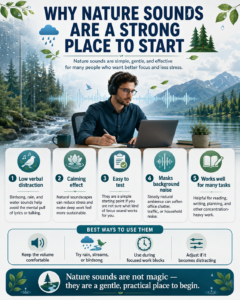
Nature sounds are one of the best sound types to test first because they are usually calm, steady, and nonverbal. Rain, ocean waves, forest birds, wind, rivers, and soft stream sounds can create a peaceful background without demanding your attention.
This matters because your brain processes words automatically. That is why songs with lyrics, podcasts, or loud conversations can make writing and reading harder. Nature sounds do not usually compete with your language brain. They create a background that can make your workspace feel less stressful.
Research on natural soundscapes suggests they may support psychological restoration, mood, and relaxation. A 2024 Scientific Reports study found that several natural soundscapes had positive effects on psychological and physiological recovery, and combined natural sounds performed especially well in that study.
For business productivity, nature sounds can work well for:
Writing blog posts
Planning business ideas
Working on websites
Studying marketing
Organizing finances
Designing lead magnets
Doing quiet creative work
Resetting after stressful phone calls
The key is to keep the volume low. The sound should sit behind your work, not take over your mind.
Part 2: Best Nature Sounds for Different Work Tasks 🌿
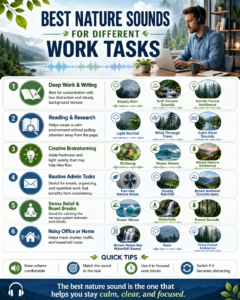
Not every nature sound feels the same. Some sounds are better for deep work, while others are better for calming down.
Rain sounds are good for writing, reading, studying, and working late at night. Rain is steady and smooth, so it can help cover background noise.
Forest sounds with birds and wind can work well for morning planning, journaling, creative ideas, and light business strategy.
Ocean waves are good when you feel stressed, rushed, or mentally tired. Waves can help create a slower rhythm after a hard day.
River or stream sounds can be good for long work sessions because they are steady but still natural.
Wind sounds can feel calming for some people, but too much wind noise may become distracting. Test it before using it for serious work.
Picture idea: Forest stream, laptop, notebook, and headphones.
Alt text: Nature sound workspace for focus, calm, and productivity.
Part 3: Soft Instrumental Music for Deep Work 🎹📈
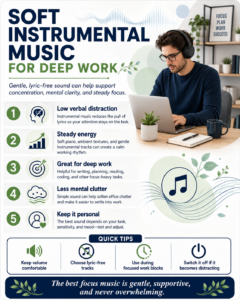
Soft instrumental music is another strong option for business productivity. The best focus music usually has no lyrics, a steady rhythm, and a calm mood. Good choices include ambient music, lo-fi beats, soft piano, light jazz, smooth electronic music, and calm cinematic background music.
Atlassian’s productivity article points to ambient music, lo-fi beats, and chill lo-fi study beats as common deep-work choices. It also notes that many people in a Spotify survey picked ambient music for studying, with slower beats being an important part of why it works.
This does not mean one playlist works for everyone. It means soft, low-distraction music is usually safer for serious thinking than loud, emotional, lyric-heavy music.
Use soft instrumental music when you are doing:
Website building
Writing sales pages
Designing graphics
Studying business skills
Creating content
Planning ads
Doing quiet office work
For repetitive tasks like cleaning up files, organizing folders, formatting pages, or sorting receipts, slightly more upbeat instrumental music may help. But for deep work, softer is usually better.
Part 4: What About Fast Music and BPM? 🥁
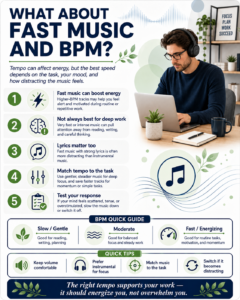
A lot of people ask: “What tempo is best for productivity?”
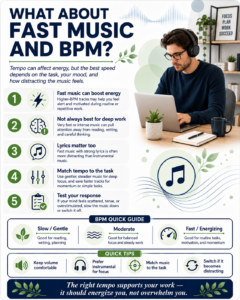
The honest answer is that it depends on the task. Atlassian discusses high-tempo music around 170–190 BPM, but that section is mainly connected to exercise research, not guaranteed desk productivity. Atlassian also says the only way to know if those findings transfer to desk work is to test it.
So do not say, “170–190 BPM is proven best for deep work.” A better and more credible statement is:
For deep work, start with slower ambient or instrumental music. For repetitive admin tasks, test faster instrumental music and compare your output.
That sounds more professional and avoids fake productivity claims.
Part 5: White Noise vs. Brown Noise for Concentration 🤍🤎
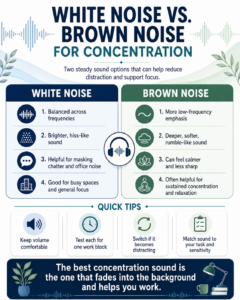
White noise and brown noise are both used to mask distractions, but they sound different.
White noise sounds like static, a fan, or an air conditioner. It has a sharper, higher sound. It can be useful when you need to cover unpredictable noise like talking, traffic, or people moving around.
Brown noise sounds deeper and warmer. It is more like heavy rain, distant thunder, a strong waterfall, or a low rumble. Some people find brown noise easier to listen to for a long time because it is not as sharp as white noise.
Pink noise sits somewhere in the middle. It can sound like steady rain or soft wind.
A 2024 systematic review found that white and pink noise may provide a small benefit on lab attention tasks for people with ADHD or high ADHD symptoms, but not for people without attention problems. That is important because it means noise does not help everyone equally.
For business productivity, use these simple rules:
White noise = best for blocking sharp distractions
Brown noise = best for a deeper, calmer background
Pink noise = best if white noise feels too harsh
Silence = best if any sound distracts you
Part 6: Avoid Hype-Heavy “Brainwave Hacking” Claims 🧠⚠️
There are many videos and apps online that promise instant focus, genius thinking, special brainwave states, or guaranteed productivity. Some of these sounds may be relaxing, but the claims often go too far.
For a trustworthy business article, avoid saying things like:
“This frequency will reprogram your brain.”
“This sound guarantees deep focus.”
“This beat makes you smarter.”
“This track forces your brain into success mode.”
A better message is:
Sound can help create a better work environment. It may reduce distractions, support relaxation, and help create a focus routine.
That kind of language is safer, more honest, and better for readers. It also looks more professional to Google and advertisers.
Part 7: The One-Week Sound Test for Business Productivity 📊✅
The best sound for productivity is personal. One person may work best with rain. Another person may need brown noise. Another person may focus better with soft piano. Someone else may need silence.
Instead of guessing, run a one-week test.
Choose one sound type and use it during your deep work for one full week. For example, use rain sounds every time you write, study, or build your business. At the end of each work session, score yourself from 1 to 10 in three areas:
Focus: How easy was it to stay on task?
Stress: How calm or tense did you feel?
Output: How much real work did you finish?
After one week, switch to a different sound type. Try soft instrumental music the next week. Then try brown noise. Then try silence.
At the end, compare your scores. The winner is not the sound that sounds the coolest. The winner is the sound that helps you finish more valuable work with less stress.
Picture idea: Simple chart showing sound type, focus score, stress score, and output score.
Alt text: Productivity sound test dashboard comparing nature sounds, music, white noise, and brown noise.
Part 8: Sound-Environment Simulator Idea 💻🎧
A sound-environment simulator is a simple tool that helps you test which sounds match your work style. It does not need to be complicated.
The tool could ask:
What task are you doing?
How stressed are you right now?
Do you prefer music, nature, noise, or silence?
Are you writing, studying, designing, planning, or doing admin work?
How much background noise is around you?
Then it could recommend a sound environment:
Rain for writing
Brown noise for blocking distractions
Soft piano for calm planning
Lo-fi beats for admin work
Ocean waves for stress recovery
Silence for high-focus reading
After the session, the tool could ask for a focus score, stress score, and output score. Over time, it would learn which sounds work best for your specific business tasks.
That kind of tool would be useful because it does not make fake promises. It helps the user test their own results.
Part 9: How to Use Nature Sounds in a Busy Workday ⏰🌿
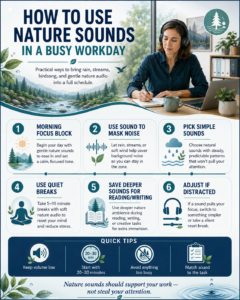
You do not have to play sounds all day. In fact, playing sounds all day can make them less powerful. A better method is to use sound as a work signal.
Try this routine:
🌅 Morning planning: forest birds or soft instrumental music
💻 Deep work: rain, river, brown noise, or ambient music
📞 After stressful calls: ocean waves or calm nature sounds
🧾 Admin work: lo-fi beats or steady pink noise
🌙 End of day: silence or very soft background sound
This works because your brain starts to connect certain sounds with certain work modes. Rain can mean writing time. Brown noise can mean deep focus. Ocean waves can mean reset time.
The sound becomes a habit trigger.
Part 10: Safe Listening Matters 🎧🛡️
Healthy sounds are only healthy if you listen safely. Do not blast white noise, brown noise, or music through headphones for hours at high volume.
The World Health Organization says safe listening depends on volume, duration, and how often you listen. WHO says 80 dB can be safe for up to 40 hours per week, while 90 dB reduces safe listening time to four hours per week. WHO also recommends keeping personal audio devices at a comfortable level and no more than 60% of maximum volume.
NIOSH recommends limiting workplace noise exposure to 85 dBA averaged over an eight-hour workday.
For business focus, the sound should be just loud enough to cover distractions. If your ears ring, your head hurts, or you cannot hear normal conversation near you, the volume is probably too high.
Conclusion: Test Sounds Like a Business Tool 🚀
Healthy sounds can be a simple but powerful part of your productivity system. Nature sounds, soft instrumental music, white noise, pink noise, brown noise, and silence can all help in different situations.
The most credible approach is not to chase magic frequencies or hype-heavy brainwave claims. The smarter approach is to test your own work environment.
Pick one sound type. Use it for one week. Track your focus, stress, and output. Then test another sound. After a few weeks, you will know what actually helps you work better.
For business productivity, the best sound is not the loudest or trendiest. The best sound is the one that helps you stay calm, focus longer, and finish the work that moves your business forward. 🌿🎧📈